


Choosing the Right Wall Art Size for Your Living Room

Updated: 3 days ago
How big should wall art be above a sofa? Aim for about 60 to 75 percent of the sofa’s width, with two-thirds to three-quarters as the sweet spot, and leave 6–10 in (15–25 cm) between the top of the sofa and the bottom of the artwork. This guide gives the right wall art size for a living room, for every common sofa width, the correct hanging height, and how ceiling height, shape and viewing distance change the answer. It is written by the designers at Nrdesign Studio, where we create large-scale canvas wall art for contemporary interiors.
At a glance:
Width: about 60 to 75 percent of the furniture’s width. Two-thirds to three-quarters is the sweet spot.
Gap above the sofa: 6–10 in (15–25 cm) between the top of the sofa and the bottom of the artwork.
Height with no furniture below: centre the artwork about 57–60 in (145–152 cm) from the floor.
The most common mistake is choosing artwork that is too small. When in doubt, go slightly larger.
Tall or double-height rooms need more scale, or a vertical format.
Test the size with painter’s tape for a day before you order.

How big should wall art be above a sofa?
Start with the furniture beneath the artwork, not only the empty wall. If the artwork will hang above a sofa, console or sideboard, the furniture is usually the better reference point. Use the table below as a starting point.
Furniture width | Recommended artwork width |
60 in / 152 cm | 40–45 in / 102–114 cm |
72 in / 183 cm | 48–54 in / 122–137 cm |
84 in / 213 cm | 56–63 in / 142–160 cm |
96 in / 244 cm | 64–72 in / 163–183 cm |
108 in / 274 cm | 72–81 in / 183–206 cm |
120 in / 305 cm | 80–90 in / 203–229 cm |
These measurements are not strict rules. Architecture, ceiling height, surrounding furniture and the visual weight of the artwork all matter, but they are an excellent starting point.
For example, an 84-inch sofa with a 30-inch canvas centred above it can look disconnected, because there is too much unused space around the artwork. Increase it to around 56–63 inches wide, and the artwork feels connected to the sofa instead of floating above it.
Why is oversized wall art often the better choice?
Many people hesitate to choose large artwork because they fear it will overpower the room. In reality, undersized artwork is the greater problem. A large canvas creates a strong focal point and allows the rest of the room to stay restrained. It works especially well in living rooms with neutral furniture, natural materials and minimal decoration, and it often creates a calmer, more sophisticated composition than several small pieces. The goal is the right relationship between art, furniture and architecture.
How high should you hang wall art?
Above a sofa: leave about 6–10 in (15–25 cm) between the top of the sofa and the bottom of the artwork. If the artwork hangs too high, it looks disconnected and the wall feels divided into separate sections.
On a wall with no furniture below: place the visual centre about 57–60 in (145–152 cm) from the floor.
Above a sofa, the artwork and the furniture should read as one composition, not two separate elements.
How does ceiling height change the right size?
A standard-height living room often suits horizontal artwork above a sofa, because the proportions follow the furniture beneath it. Tall rooms, double-height living spaces and staircase walls need a different approach. A vertical artwork emphasises the height of the architecture, while a very large square or portrait canvas gives visual weight to a space that might feel empty. In a double-height room, a small artwork at standard eye level can look lost even if its dimensions would normally be right. The larger the architectural volume, the more confidently you can increase the scale.
Should wall art be horizontal, vertical or square?
Let the shape of the space decide.
Horizontal: a long sofa creates a horizontal composition, so landscape artwork feels balanced above it.
Vertical: works well on narrow walls, between windows, beside openings, and where you want to add height.
Square: versatile, especially above a sofa, fireplace or console when the architecture is symmetrical.
The wall usually tells you what proportion it needs.
Should you choose one large artwork or several smaller pieces?
Both can work, but they create different moods. One large artwork feels quieter, stronger and more architectural, and it gives the eye somewhere to rest. A gallery wall creates more movement, and suits eclectic or collected interiors. For a modern or minimalist living room, one large artwork is often the stronger solution. If you choose a gallery wall, treat the whole arrangement as one artwork: its total width should still relate to the sofa or furniture beneath it. Pieces scattered across a large wall can make the room feel fragmented.
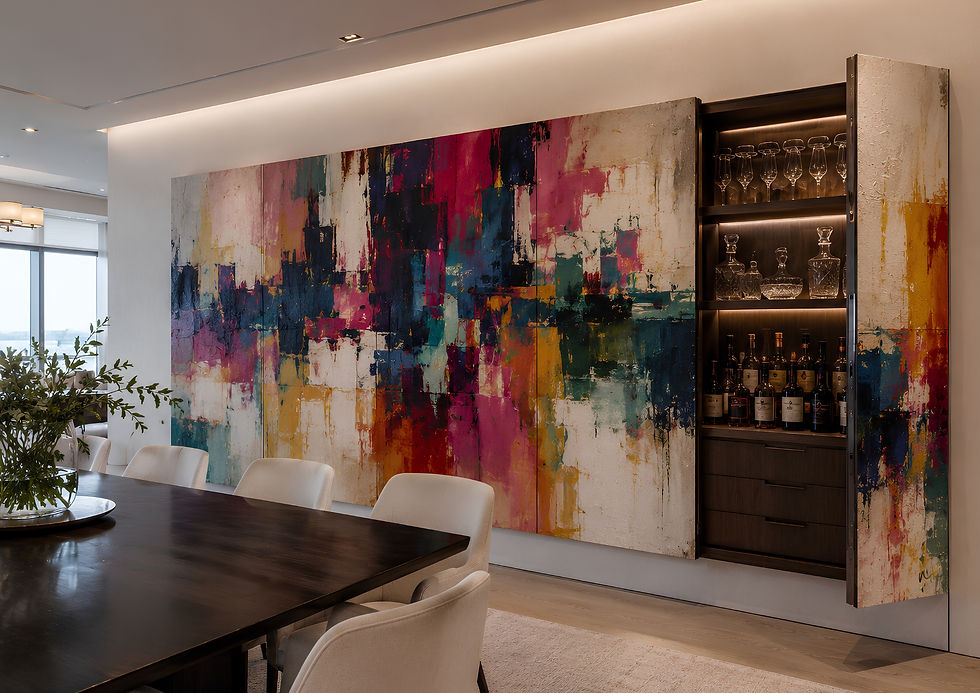
A large wall also does not always need several artworks. A single large canvas is especially effective when the wall already has strong architecture, such as stone, wood panelling, built-in cabinetry, large windows or textured finishes. In many well-designed interiors, restraint is what creates the sense of luxury.
How far away will the artwork be viewed?
In a compact living room, people stand only a few feet from the canvas, so extremely large artwork with intense detail can feel overwhelming. In a larger open-plan home, the artwork may be seen from across the room, so a larger scale is needed for it to keep its presence. Before ordering, stand at the main entrance to the room, or where you most often look at the wall, and imagine the artwork from there.

How do you test the size before you order?
Use painter’s tape to mark the proposed dimensions directly on the wall, and leave it for a day. Walk into the room several times, sit on the sofa, and look from different angles. This quickly shows whether the size feels too small, too large or right. A size that sounds very large in centimetres or inches often looks completely appropriate once it is marked on the wall.
What are the most common wall art sizing mistakes?
Choosing artwork that is too small.
Hanging it too high, which separates it from the furniture beneath.
Choosing a piece only because it matches the sofa colour. Art does not need to repeat every colour in the room. It is often more interesting when it adds contrast, depth or an unexpected tone.
Choosing a size because it is convenient to buy or ship. The artwork should first be right for the wall. Format, framing and delivery come second.
What if you love an artwork but the standard size is wrong?
Every room has different architecture. A wall between two windows may need a very specific width, a long sectional may need artwork wider than a standard format, and a double-height wall may need considerably more scale. Our artworks are available as rolled, stretched and floating-frame canvas. Standard sizes go up to 45×60 in (114×152 cm) in portrait or landscape, and up to 52.5×52.5 in (133×133 cm) square in a floating frame, which covers sofas up to about 84 in (213 cm) wide. For wider sofas, larger walls or unusual proportions, we offer custom sizing. See every size in our Sizes & Formats guide.
What is the right wall art size for a living room?
Neutral living rooms, in cream, greige, taupe, stone, beige and warm grey, are a quiet background that lets art add personality without overwhelming the space. The artwork can repeat a few tones already in the room and add deeper accents, texture or contrast. A cream and taupe interior, for example, works well with artwork containing charcoal, muted gold, warm brown, terracotta or subtle blue-green. The goal is colour harmony, not a perfect match.

Before you buy: five questions
How wide is the furniture beneath the artwork?
What are the available wall dimensions?
How high is the ceiling?
From where will it normally be viewed?
What shape is the space: horizontal, vertical or square?
If those five work together, choosing the artwork becomes much easier. For other rooms, see our wall art size guide for every room.
The designer’s rule to remember
Start with the dimensions of your space. Consider the furniture beneath the artwork, and pay attention to ceiling height and viewing distance. When you are choosing between slightly too small and slightly larger, the larger option is often the more convincing one. A well-scaled artwork should look as though the room was designed around it, not as though it was added afterwards.
Explore the Nrdesign Studio collections. The paintings shown are from the La Vie En Rose Collection.
Related reading: Should Wall Art Match Your Sofa? · Why Oversized Wall Art Matters


Comments